The Honest Post-Mortem
I shipped a product people validated as solving a real pain. Even with the price gate removed, almost none of them showed up to use it. Here's what I missed about wanting a thing versus doing it.
Published
I Shipped a Real Problem and Nobody Showed Up
A post-mortem of olllo, a performance-review and accomplishment-tracking tool I built solo across four months and shut down in March 2026.
Opening
People told me it was a real problem. Every conversation. Performance reviews that felt arbitrary. 1:1s that surfaced nothing. The 9pm panic of trying to reconstruct six months of work the night before a self-review was due.
I built olllo to solve that. It works. People who tried it said it works. Even with the price gate removed, almost none of them showed up to use it consistently.
This is the part of the case study where I was supposed to have a clean answer for why. I don’t. What I have is a set of signals I read correctly, a set I explained away, and a decision made in March 2026 to stop building and start writing about what I learned.
The closest analogue is the fitness or weight-loss app. People articulate the goal cleanly. They will tell you, with care, that health is important. They will sign up. They will not, in numbers that build a business, show up to do the work. olllo lived in that category, and the signals were there in the data before I let myself read them.
The bet
The hypothesis was simple. If you can’t remember your work, you can’t advocate for it, and your career compounds slower than your effort deserves. The script I wrote for the first YouTube video argues this cleanly: it names recency bias, it cites Kahneman, it frames the problem as memory rather than motivation. I believed it when I wrote it. I still believe it.
The user bet was that low-friction daily capture, reinforced by weekly reflection and quarterly summaries, would compound into a case file that made reviews, 1:1s, and compensation conversations dramatically less stressful.
The business bet was narrower: that enough people felt this pain acutely enough to pay roughly $8/mo on an annual plan ($96/year before the beta discount) for a tool that replaced the ad-hoc notes app or Google Doc they were already mismanaging.
The first bet was right about the pain and wrong about the behavior. Daily capture compounds only if you show up daily, and the cohort A retention says you mostly don’t. The second bet rode on the first, and they fell together.
What I built
Four months of solo work. Full architecture details live in Solo Architecture; the short version:
- A Next.js 16 web app with onboarding, reflections, goals, and accomplishment tracking
- A React Native mobile app with voice capture that transcribes audio and extracts structured STAR-format entries
- A PWA for the in-between surface
- A multi-agent reflection flow using Claude Sonnet and Haiku across tiered calls
- Infrastructure most solo products skip: rate limiting, feature flags, email authentication, consent management, referral loops, waitlist, free-forever grants (the full growth-stack story is in Growth Engineering)
40+ numbered feature branches shipped, each gated through a speckit workflow that required a spec, clarifications, a plan, tasks, and an analysis pass before implementation. The discipline story lives in Culture as Code.
The thing worked. That’s not in dispute.
What 14 people said they wanted
The waitlist had 30 people. Fourteen filled out the survey, and the pattern in the responses was consistent enough that I should have read more meaning into it than I did.
The modal respondent was a senior individual contributor at an enterprise company — staff-level engineers and designers, plus a band of people in career transition. Two-thirds heard about olllo through LinkedIn or a direct referral; almost none arrived from a search or a content channel I had not personally seeded.
The pain they named was real and articulated cleanly: performance reviews, interviews and resume updates, weekly planning, and the recurring imposter-syndrome moment of “what have I actually been working on?” Six respondents cited reviews specifically. Seven cited interviews. Across role levels, the shape held.
What they said they wanted built was a clean record of wins they could search later, a promotion-ready career story, and weekly reflection prompts that surface patterns. Goal tracking and a thirty-second “capture a win” both rated highly. Across the four feature-interest scores, no single feature dominated — respondents wanted the whole shape, not one piece of it.
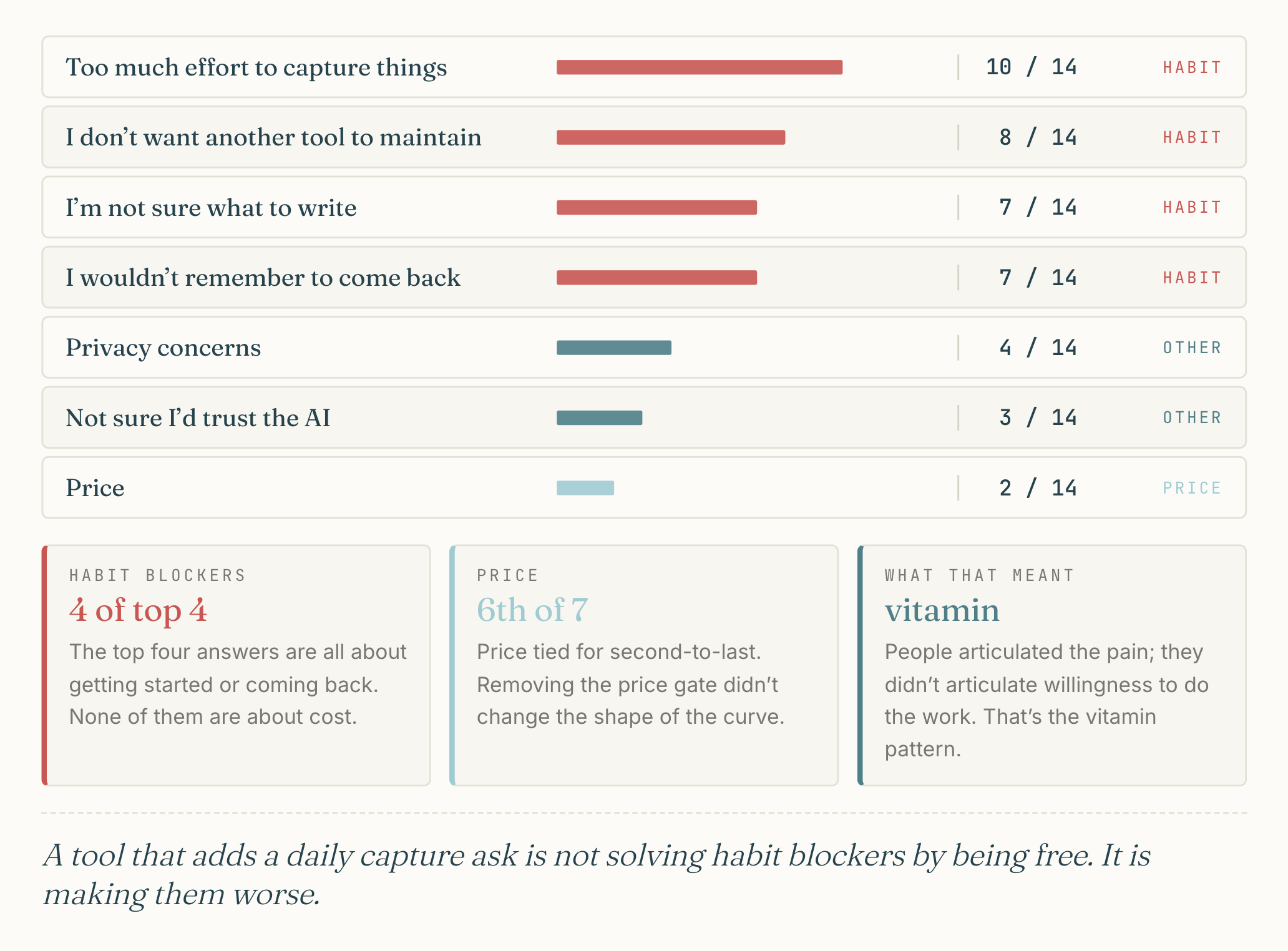
What they said would stop them is the section this post-mortem turns on. The top blockers, in order: too much effort to capture things, I don’t want another tool to maintain, I’m not sure what to write, I wouldn’t remember to come back. Privacy concerns scattered through. Price was not in the top blockers. Habit and inertia were. That should have been louder to me than it was.
 The magic-wand answers, paraphrased: “Identify a career path and prepare for success.” “Keep me engaged with itself — too often the things I want to work on peter off.” “Push me to develop the habit.” “Help me organize my energy toward highest impact, for me, not my company.” Read as a set, those wishes describe a coaching product more than a tracking product. olllo was a tracking product.
The survey was a clear, useful read. The feature priorities were visible. So was the willingness-to-engage signal — and it was thinner than I let myself see at the time.
The signals I saw clearly
The numbers, as of March 2026:
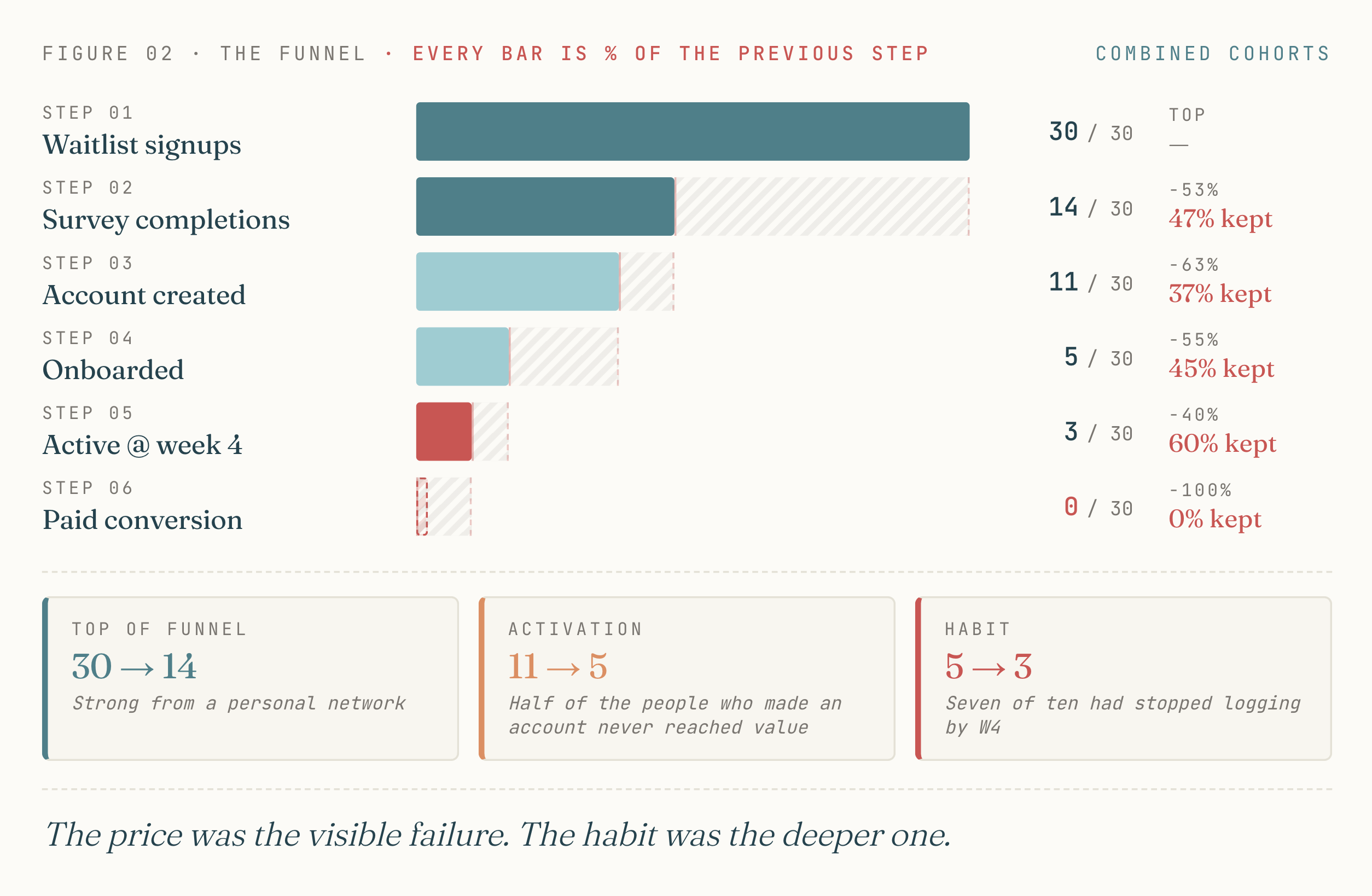
| Metric | Value |
|---|---|
| Waitlist signups | 30 |
| Survey completions | 14 (47%) |
| Cohort A — invited (no payment, n=10): created → onboarded → active@1mo | 9 / 5 / 3 |
| Cohort B — invited (Stripe gate, n=20): created → onboarded → active@1mo | 2 / 0 / 0 |
| Paid conversions | 0 |
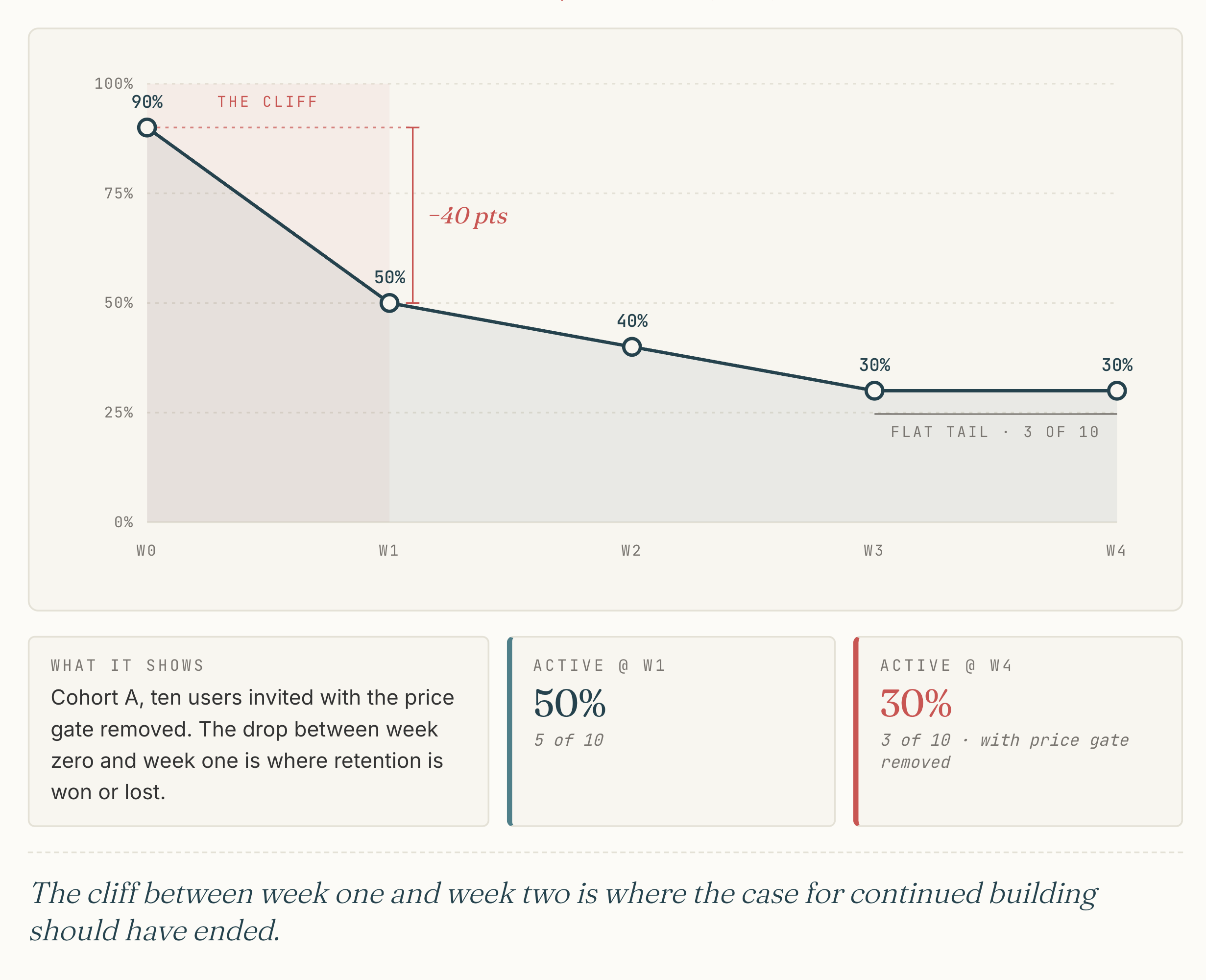
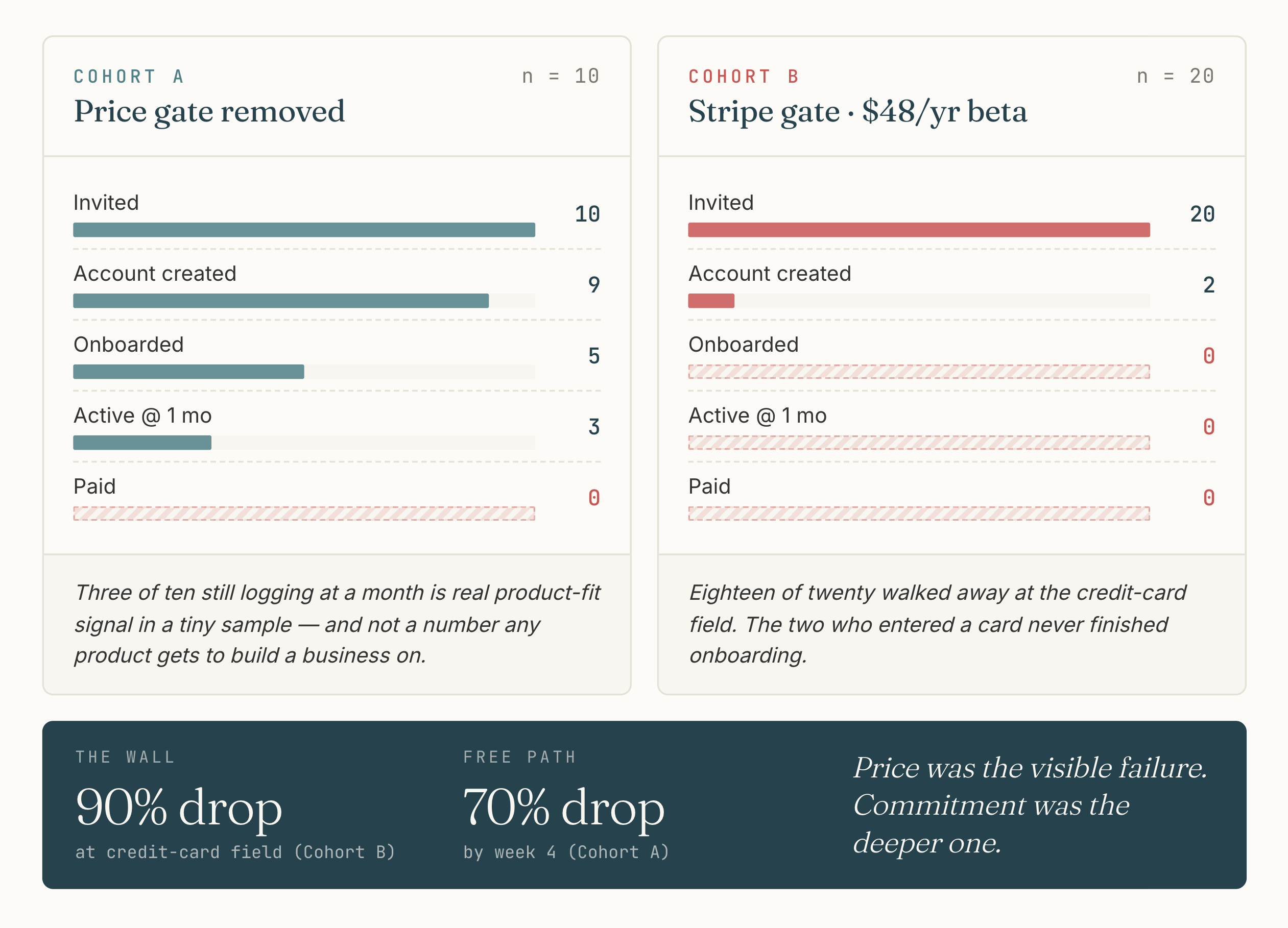 The split between cohorts was the natural experiment, and the cohort B funnel — eighteen of twenty users walking away at the credit-card field, the two who entered a card never finishing onboarding — is the readable answer to “will people pay for this.” Growth Engineering covers the cohort design and instrumentation in detail. The post-mortem-relevant version: even with the price gate removed, half of cohort A onboarded and three of ten were still logging weekly a month later. That number is real product-fit signal in a tiny sample, and not a number any product gets to build a business on.
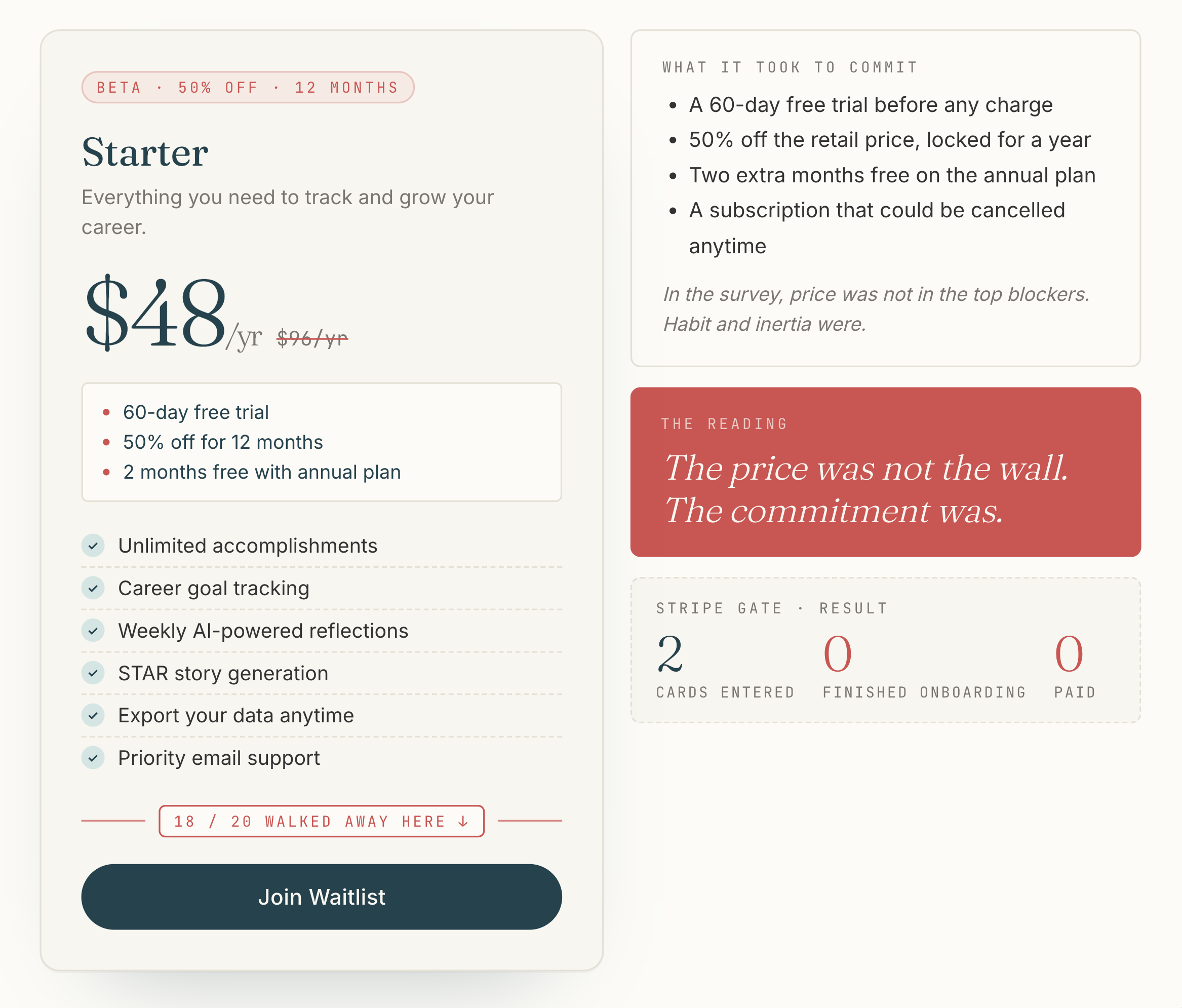
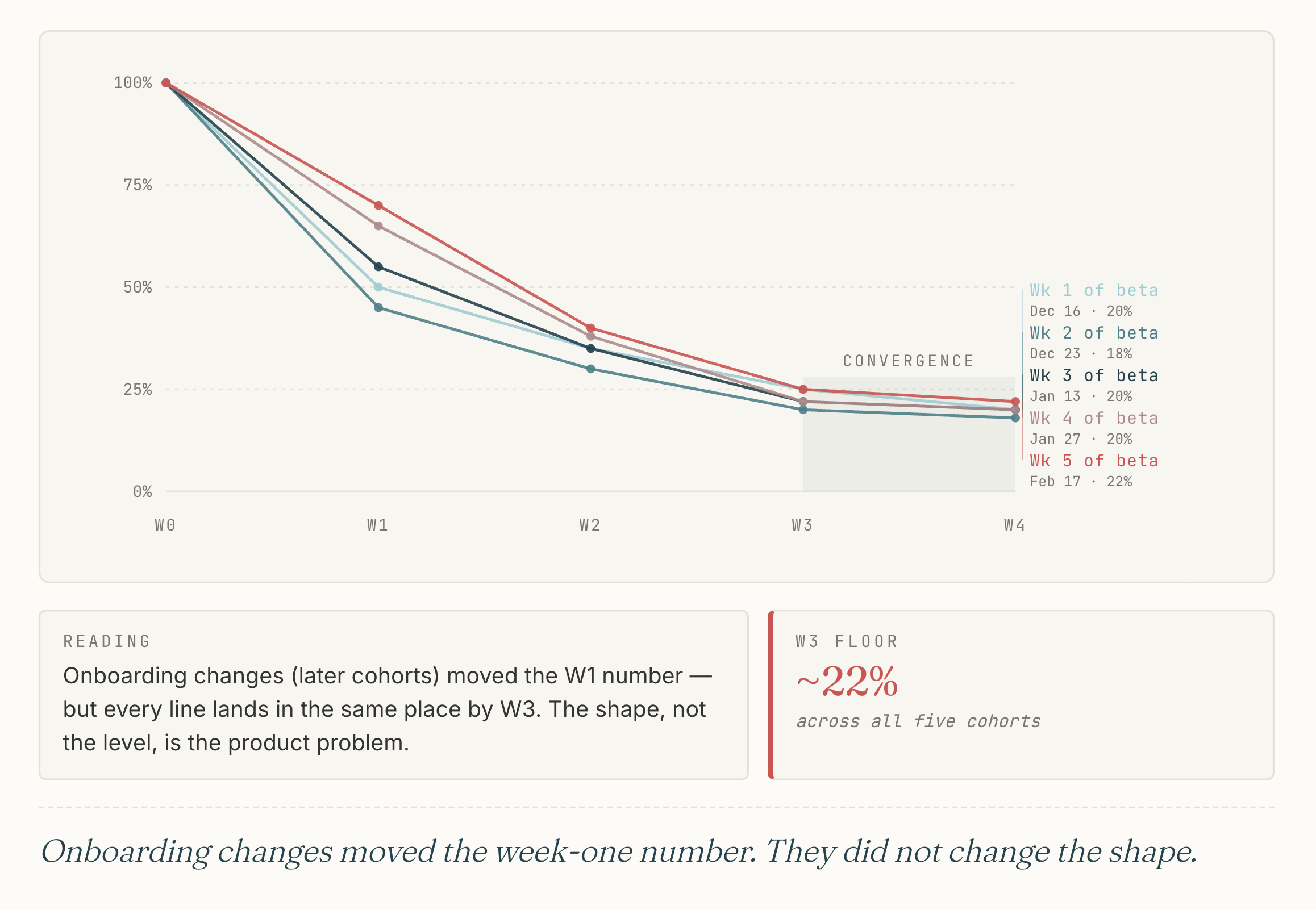 Read without flinching, that funnel says: strong top-of-funnel from a personal network, a hard wall at the credit-card gate, and — when the gate is removed — engagement so thin that seven of the ten free cohort had stopped logging by week four. Zero paid conversions on either path. The price was the visible failure. The habit was the deeper one.
The qualitative signal was consistent. I captured it in a note to myself: “People identify it as a pain point to keep track of accomplishments and prep for 1:1s and reviews, but they don’t seem willing to invest in it.” That sentence is the whole post-mortem in miniature. Acknowledgment without investment is the category-definition of a vitamin rather than a painkiller — the workout-app pattern, the weight-loss-app pattern, the nutrition-tracker pattern. People articulate the goal, sign up to solve it, and don’t reliably show up to do the work. I wrote the sentence and kept building.
The signals I explained away
This is the section that matters.
The metric I kept reassuring myself about was the survey itself. Fourteen people answered fourteen questions with care — these were not the throwaway responses of people who were casually interested. The depth and specificity felt like signal. The mistake was treating well-articulated pain as adjacent to willingness to show up. They are different things, and the survey already told me so. Under what would stop you from using olllo regularly, the top answers were habit blockers, not pricing blockers: too much effort, another tool to maintain, wouldn’t remember to come back. A tool that adds a daily capture ask is not solving those by being free; it is making them worse.
The pattern is visible in the git history. Every time the numbers were soft, I added a feature. Voice capture. Multi-agent reflection. Smarter summaries. Referral loops. Each one was defensible in isolation, and each one was a way of not confronting the base rate the survey had already drawn — that the people who articulated this pain most clearly were also articulating, in the same survey, why they would not show up daily to solve it.
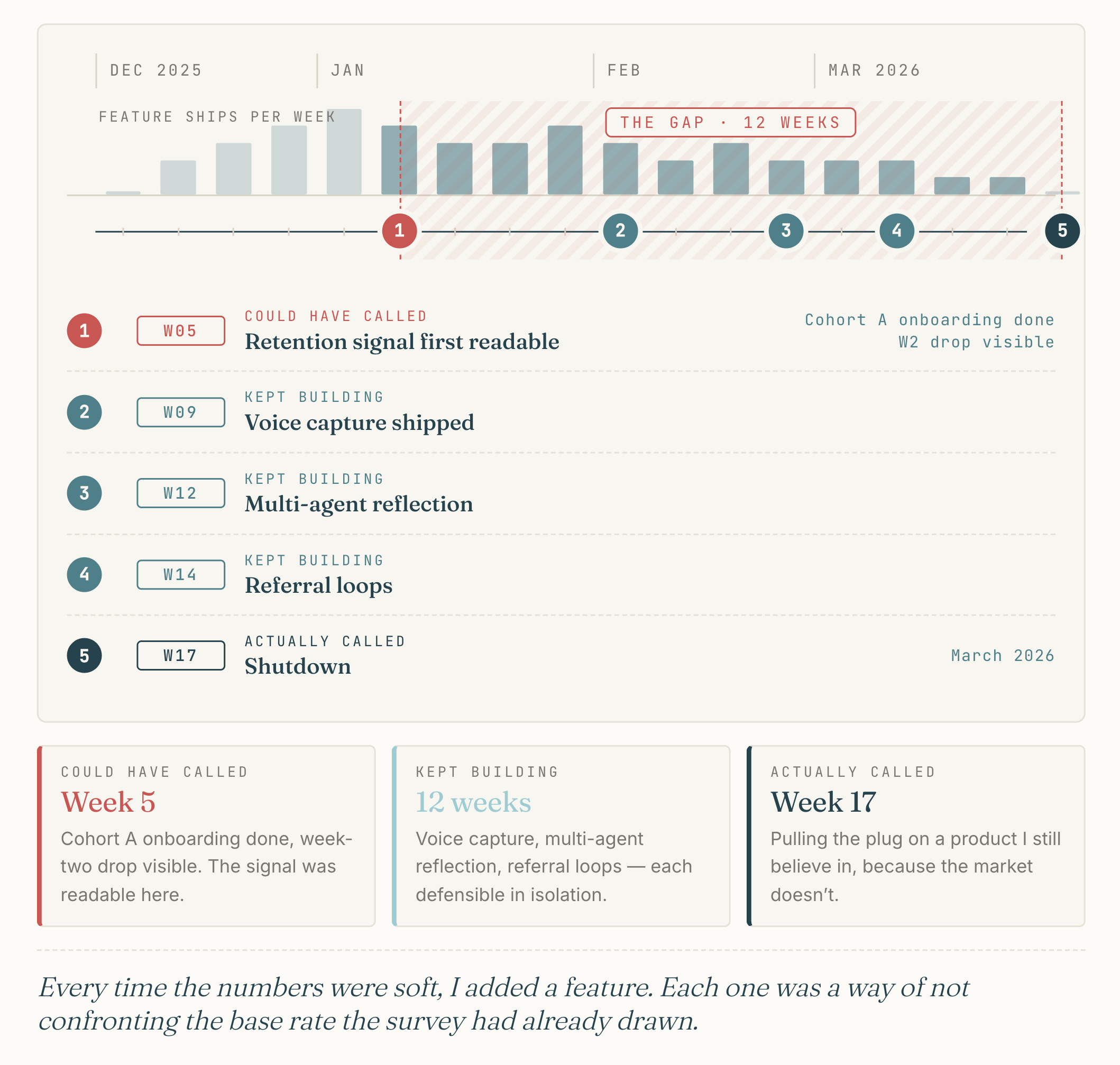 There is a version of this product that would have worked. It probably does not include voice capture. It probably includes a conversation I did not have enough of: “Would you pay $X today, before I build a single screen?” That conversation costs nothing and it would have told me in a few weeks what it took me four months and a cohort experiment to confirm.
What I’d do differently
Test the habit before the tool. A cohort of ten people, with weekly fifteen-minute calls, asked to capture three accomplishments by the end of week one using nothing but a notes app. If the habit doesn’t form for ten people who agreed to a call, it will not form for ten thousand who never will. This is the experiment that costs nothing, takes two weeks, and tells you whether the rest is worth building.
Pre-sell before build. A landing page, a Stripe checkout, a promise to refund if I don’t ship in 60 days. If 30 people pay, there’s demand. If 3 people pay, I know before writing a line of code. I had all the infrastructure to run this test and ran it too late.
Narrower ICP. Not “knowledge workers who have performance reviews.” That is almost everyone. Something like “senior engineers at companies with formal promotion packets, actively prepping for a cycle in the next 90 days.” Urgency is the filter that separates painkiller from vitamin, and I spent too long recruiting beta users who had the problem in principle rather than the problem this quarter.
Import over habit. The daily-capture habit is the product’s largest ask and its largest conversion killer. A version that reads existing Slack, email, and calendar signal and pre-populates the case file would remove the cold start. The habit can come after the value is obvious, not before.
A willingness-to-pay experiment in month one, not month four. The hardest thing to un-know in solo building is the sunk cost of a working product. Ask the uncomfortable pricing question while the product is still cheap to kill.
A single activation event to optimize, not a funnel. Not “they used it in week one.” Something sharper, like “they walked into a real 1:1 with notes this tool generated.” Everything else is a proxy.
Measure with people first, instrumentation second. Fifteen-minute calls with the first ten or twenty users tell you more in a week than a drip system tells you in three months. The growth stack would have surfaced the demand thinness eventually; the calls would have surfaced it in week two. The full version of this lesson is in Growth Engineering.
What I’d still do the same
The problem framing. The memory-and-recall reframe holds up. The three video scripts still read as sharp product thinking and I’d use them to open any future pitch in the career-development space.
Shipping solo with team-grade discipline. Speckit, the constitution file, the merge gates. These kept me out of the classic solo trap of endless scope creep disguised as progress. Detailed in Culture as Code.
Tiered model strategy with latency-first selection. Haiku for fast classification, Sonnet for interactive reasoning, no single-tier hammer. The UX stayed snappy across thirty-eight features (and the monthly AI bill stayed within reason as a side effect, but that was not what picked the model). Detailed in AI Product Craft.
Betting on the shutdown. The decision to stop is the judgment call I’m most confident in. Pulling the plug on a product I still believe in, because the market doesn’t, is the skill I most want this portfolio to demonstrate.
What I’m taking with me
A codebase I’d hire the person who wrote it. A set of product decisions I can defend in detail. A sharper read on the gap between “interesting problem” and “viable product.”
If you’re reading this as a hiring signal: the thing I want you to notice is not that olllo shipped. It’s that it stopped.